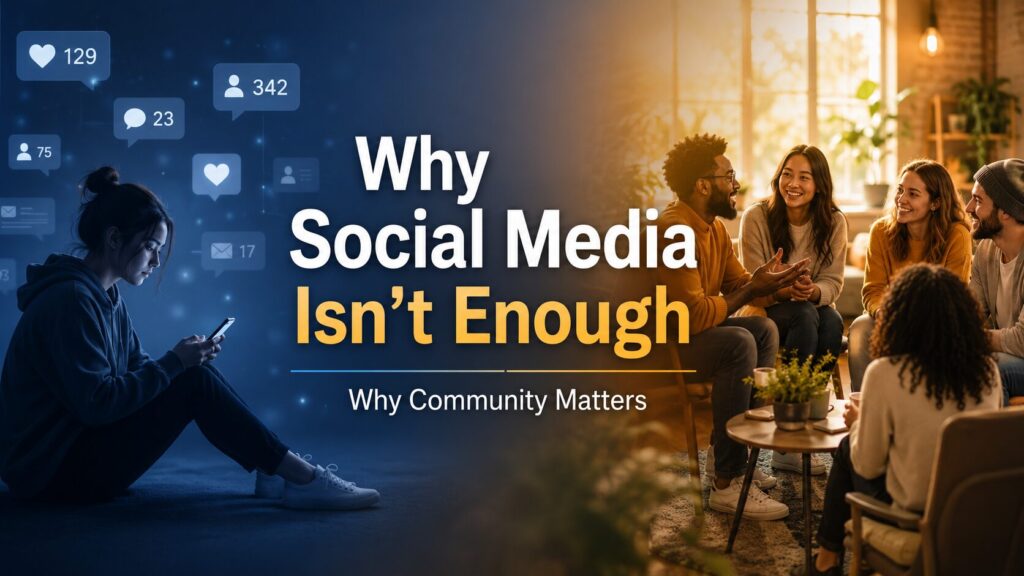
Social media has changed the way we communicate. It has given everyday people a voice, helped small businesses grow, allowed creators to build audiences, and made it easier than ever to share ideas with the world.
But let’s be honest.
Social media is not the same thing as community.
A follower is not always a friend. A like is not the same as loyalty. A comment section is not the same as a real conversation. And having thousands of people watching your content does not mean you have people standing beside you when life gets hard.
That is why social media isn’t enough.
If we really want connection, support, growth, accountability, and meaningful change, we need something deeper. We need real community.
Social Media Creates Attention, But Community Creates Connection
Social media is built for attention. Every platform wants people scrolling, reacting, sharing, and coming back for more. That means the loudest, most emotional, most controversial content often gets pushed the hardest.
But attention is not the same as connection.
You can go viral and still feel alone. You can have followers and still have no real support system. You can post every day and still wonder who actually knows you, believes in you, or has your back.
Community is different.
Community is where people are known. It is where people show up consistently. It is where people can disagree without disappearing. It is where support is not based on an algorithm, a trend, or a viral moment.
Social media can introduce people to your message, but community is what gives that message roots.
Social Media Is Controlled by Algorithms
One of the biggest problems with relying only on social media is that you do not control the platform.
You can spend years building a page, group, or audience, and one algorithm change can crush your reach overnight. Your followers may want to hear from you, but that does not mean the platform will actually show them your content.
That is a dangerous foundation.
When your entire connection to people depends on a company’s algorithm, you are building on rented land. You do not truly own the relationship. The platform decides who sees your message, when they see it, and how far it spreads.
Community gives you more ownership.
A real community is not just people who occasionally see your posts. It is people who intentionally gather around shared values, shared goals, and shared conversations. They do not just stumble across your content. They choose to be part of something.
That choice matters.
Community Builds Trust Over Time
Trust does not usually happen from one post, one video, or one viral clip. Trust is built through consistency.
People need to see how you think. They need to hear how you respond to disagreement. They need to know what you stand for when it is popular and when it is not. They need to know that you are not just chasing clicks, outrage, or attention.
Social media can start that process, but community strengthens it.
Inside a real community, people can ask questions. They can share their own experiences. They can challenge ideas. They can learn from each other. They can build relationships that go beyond surface-level reactions.
That is where trust grows.
And once trust is built, the relationship becomes stronger than any algorithm.
Social Media Often Rewards Division
Another reason social media isn’t enough is because many platforms reward conflict.
Arguments get engagement. Outrage gets clicks. Division keeps people scrolling. The more emotional the content, the more likely it is to spread.
That does not mean every strong opinion is wrong. Sometimes the truth needs to be said boldly. But when everything becomes about winning an argument, owning the other side, or keeping people angry, real conversation gets lost.
Community gives people a better place to talk.
In a strong community, people can have difficult conversations without turning everything into a performance. They can debate ideas without becoming enemies. They can focus on solutions instead of just reacting to distractions.
That is important, especially in a world where so many people feel politically, socially, and culturally divided.
Real community reminds us that most everyday people have more in common than the internet wants us to believe.
Community Gives People a Sense of Belonging
Research from the U.S. Surgeon General shows that social connection plays a critical role in individual and community health
People do not just want information. They want belonging.
They want to feel like they are part of something. They want to know they are not the only ones asking questions, struggling with life, raising kids, building businesses, fighting through hard times, or trying to make sense of the world.
Social media can make people feel connected for a moment, but community gives people a place to return to.
That is powerful.
A real community can encourage people when they are tired. It can challenge them when they are wrong. It can celebrate their wins. It can help them stay grounded when the world feels chaotic.
Belonging matters because people are not built to do life alone.
Community Turns Followers Into Participants
On social media, most people are spectators. They watch, scroll, like, and move on.
But community invites people to participate.
Instead of just consuming content, people can contribute ideas. They can join conversations. They can support each other. They can help shape the direction of the group. They become part of the mission instead of just watching from the sidelines.
That is how movements are built.
Not through followers alone. Not through viral posts alone. Not through empty engagement.
Movements are built when people believe they have a role to play.
Social Media Should Be the Doorway, Not the Destination
This does not mean social media is bad. Social media is a powerful tool when used the right way.
It can help people discover your message. It can help you reach new audiences. It can help you educate, entertain, inspire, and speak truth to people who may have never found you otherwise.
But social media should be the doorway, not the destination.
The goal should not just be to collect followers. The goal should be to build relationships. The goal should be to move people from passive scrolling into real connection.
That could mean a private group, an email list, a local meetup, a membership community, a book club, a podcast audience, or any space where people can go deeper than a quick reaction.
Social media gets people’s attention.
Community keeps people connected.
Why Community Matters More Than Ever
We live in a time where people are surrounded by noise but starving for meaning.
There is more content than ever, but many people feel more disconnected than ever. There are more opinions than ever, but fewer places where people feel truly heard. There are more platforms than ever, but not enough spaces built on trust, honesty, and shared purpose.
That is why community matters.
Community gives people something social media cannot fully provide: stability, identity, accountability, support, and belonging.
A strong community reminds people that they are not just users, followers, consumers, or numbers on a screen. They are human beings with voices, stories, values, and purpose.
Conclusion
Social media is useful, but it is not enough.
It can help spread a message, but it cannot replace real connection. It can build visibility, but it cannot automatically build trust. It can create attention, but attention without community fades fast.
If you want something that lasts, build community.
Build a place where people feel seen. Build a place where honest conversations can happen. Build a place where people can grow, learn, challenge each other, and stand together.
Because at the end of the day, likes disappear. Trends move on. Algorithms change.
But real community?
That is where the power is.
Call to Action
If this message hits home, do not just scroll past it. Start thinking about the people around you. Who are you building with? Who are you learning from? Who are you showing up for?
Social media may help us find each other, but community is what keeps us together.
Join Rock Nation – honest conversations and real connections