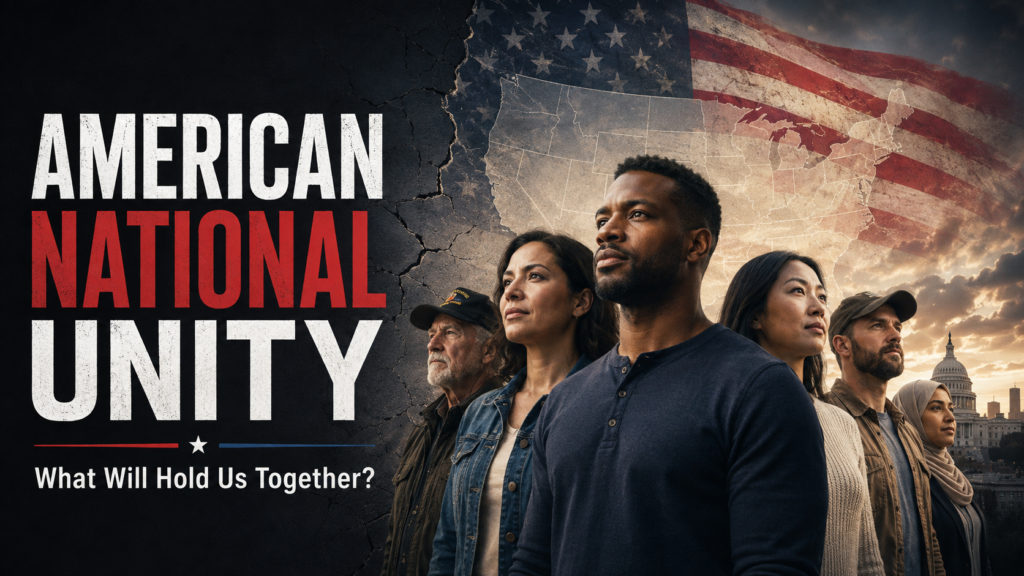
American National Unity: What Will Hold Us Together?
America has a problem that goes deeper than Republicans versus Democrats, conservatives versus liberals, or whatever political fight is dominating cable news this week.
We are facing a crisis of American national unity.
The question isn’t simply whether Americans can agree on politics. We probably never will, and that’s okay. A free country should have disagreements.
The real question is much more important:
Do Americans still see themselves as one people?
Because if the answer eventually becomes no, then all the political arguments we’re having today may become irrelevant.
A nation cannot survive indefinitely when the people living inside it no longer believe they belong to the same nation.
And right now, America seems dangerously close to forgetting what actually makes us Americans.
American National Unity Is About More Than Politics
America has become one of the largest and most diverse societies in the world.
Different races.
Different religions.
Different cultures.
Different political beliefs.
Different economic realities.
Different regional identities.
None of those differences automatically make America weaker. Diversity can be a tremendous strength when people still share something larger that connects them.
But that’s the part we seem to be losing.
There was once a much stronger understanding that whatever our differences might be, we were still Americans first.
Today, that shared identity feels increasingly fragile.
We don’t trust the same institutions. We don’t consume the same media. We don’t agree on our history. We don’t agree on our culture. Sometimes it feels like we don’t even agree on what country we’re living in.
Research from the Pew Research Center on Americans’ trust in one another also shows how political polarization and increasingly negative views of the opposing party are connected to America’s broader challenge with social trust.
And that should concern everyone.
Because American national unity doesn’t require Americans to become identical. It requires Americans to believe they belong to something together.
Without that shared identity, we’re not really a nation.
We’re just millions of people occupying the same geographic territory.
Nations Need Something That Holds Them Together
People often assume countries are permanent.
They’re not.
History is filled with nations, empires, federations, and political unions that once appeared permanent until suddenly they weren’t.
Countries survive because enough people believe in the country itself.
They see other citizens—even strangers—as members of the same larger community.
That’s why someone living in Arizona can feel connected to someone living in Pennsylvania whom they’ve never met.
They’re both Americans.
That invisible connection matters.
But when that connection disappears, societies begin becoming collections of competing groups.
Race against race.
Religion against religion.
Region against region.
Political tribe against political tribe.
Eventually people stop asking:
“What’s best for America?”
And start asking:
“What’s best for my group?”
That’s where national cohesion begins to break down.
We Need to Rebuild a Shared American Identity
If America is going to remain united, we need to start rebuilding a shared national identity.
That’s easier said than done.
America doesn’t have one race, religion, ancestry, or cultural background capable of naturally defining the entire country.
And maybe that’s actually our opportunity.
Being American doesn’t have to be based on blood.
It can be based on belonging.
It can mean accepting certain shared responsibilities, values, customs, and expectations that allow people from completely different backgrounds to live together as one country.
But that only works if we’re willing to admit that assimilation and national identity still matter.
We can’t continuously divide ourselves into smaller demographic categories and then act surprised when nobody feels connected to the larger country anymore.
At some point, there has to be an us.
And that “us” needs to mean Americans.
Mass Immigration and American National Unity
One of the most difficult conversations surrounding American national unity involves immigration.
Before someone immediately labels that statement anti-immigrant, that’s not the argument.
The issue is scale and speed.
Every society has limits on how quickly it can absorb major demographic and cultural changes while maintaining social cohesion.
Even when immigrants are hardworking, decent people who genuinely want a better life, rapid population change can still create pressure on housing, schools, infrastructure, wages, public services, and communities.
More importantly, assimilation takes time.
People need opportunities to become part of their new country rather than simply living inside it.
That’s why I believe America should seriously reconsider the level and pace of migration occurring today.
This isn’t about hating people who want to come here.
It’s about making sure the country they’re coming to remains stable enough to actually offer the opportunity they’re searching for.
A nation has every right—and responsibility—to consider how immigration affects its existing citizens and long-term national cohesion.
Artificial Intelligence Changes the Immigration Debate
There’s another factor we aren’t talking about enough: artificial intelligence.
We are entering a period where AI and automation could dramatically reshape portions of the American workforce.
Some occupations will grow.
Others may require fewer workers.
Entire industries may change as businesses discover new ways to use artificial intelligence.
Even the U.S. Bureau of Labor Statistics is studying AI’s impact on employment projections, with the effects differing significantly depending on the occupation and industry.
That’s important.
If technological disruption changes the demand for human labor in certain sectors, America needs to be willing to rethink policies built around continuously expanding the labor supply.
Our first responsibility should be ensuring American citizens have opportunities to build stable lives.
Before Washington worries about solving everybody else’s problems, perhaps it should focus a little more attention on Americans struggling here at home.
Charity is admirable.
But a government exists primarily to serve its own citizens.
That shouldn’t be controversial.
A Common Language Can Strengthen American National Unity
There’s another simple step America can take toward rebuilding national cohesion.
We need a common language.
And that language should be English.
Again, this doesn’t mean other languages are inferior.
Speak Spanish at home.
Speak French.
Speak Arabic.
Speak Mandarin.
Celebrate your heritage.
Teach your children where your family came from.
None of that threatens America.
But a functioning nation still needs a language that allows citizens from completely different backgrounds to communicate with one another.
Language creates common references.
Common stories.
Common conversations.
Common culture.
It’s one of the most powerful tools humans have for building connections between people who otherwise may have almost nothing in common.
English can provide that bridge.
In fact, English already plays a role in the citizenship process. USCIS naturalization requirements include English and civics testing, subject to certain exemptions and accommodations.
If someone becomes an American citizen and doesn’t yet speak English, we should help them learn.
Government programs, nonprofits, churches, businesses, and community organizations could all play a role.
The message shouldn’t be:
“You don’t belong because you don’t speak English.”
It should be:
“You’re one of us now. Let us help you participate fully.”
That’s assimilation without hostility.
And America desperately needs more of it.
Political Division Is Distracting Us From the Bigger Problem
Meanwhile, Americans are encouraged every day to hate one another.
Republican versus Democrat.
Left versus right.
Black versus white.
Men versus women.
Religious versus secular.
Urban versus rural.
Pick your team.
Choose your enemy.
Stay angry.
The outrage machine depends on it.
Social media rewards conflict because conflict creates engagement.
Political media thrives on controversy.
Politicians raise money by convincing supporters that the other party represents an existential threat.
And while ordinary Americans fight each other, the political and economic class seems to keep doing just fine.
Maybe we’re fighting the wrong battle.
Most Americans want many of the same basic things.
A safe neighborhood.
A decent job.
Affordable housing.
A good education for their children.
A government that doesn’t waste their money.
The freedom to live their lives.
The opportunity to leave something better behind for their kids.
That’s a pretty strong foundation for American national unity if we decide to build on it.
We Have More in Common Than We’re Told
That may be one of the biggest lies Americans have been sold:
That we’re hopelessly different.
We’re not.
Yes, real disagreements exist.
Some are serious.
Some probably cannot be completely resolved.
But disagreements don’t automatically make people enemies.
Families disagree.
Friends disagree.
Communities disagree.
A healthy country should be capable of disagreement without convincing half the population that the other half is evil.
We have far more in common than our political system encourages us to recognize.
The problem is that unity doesn’t generate nearly as much money, power, or attention as division.
Angry citizens are easy to manipulate.
United citizens are much harder.
Maybe that’s why we’re constantly encouraged to look sideways at one another instead of upward at the people making the decisions.
What Does It Mean to Be an American?
Ultimately, rebuilding American national unity requires answering one fundamental question:
What does it mean to be an American?
Not racially.
Not religiously.
Not politically.
Nationally.
What values should connect us?
What responsibilities do citizens have toward one another?
What culture and traditions should we preserve?
What principles are non-negotiable?
What should someone arriving from another country understand about joining America?
And what responsibilities do people born here have toward preserving it?
Those are conversations worth having.
Because citizenship should mean more than simply possessing paperwork.
It should mean belonging to a country and accepting some responsibility for its future.
America Doesn’t Need Uniformity—It Needs Unity
American national unity does not mean everybody has to think alike.
That’s impossible.
And frankly, it would be terrible.
America’s strength has always included disagreement, innovation, independence, and the freedom to challenge authority.
Unity isn’t conformity.
Unity means we can disagree while still seeing each other as Americans.
It means recognizing that we’re sharing the same national house.
We can argue over how the furniture should be arranged.
We can argue about who should pay for the repairs.
We can even argue about who’s been leaving dirty dishes in the sink.
But burning the house down because we didn’t get our way isn’t going to help anybody.
The Choice Is Ours
America’s future isn’t predetermined.
We can continue down the path of tribal politics, cultural fragmentation, declining trust, and endless division.
Or we can start rebuilding something.
A shared language.
A stronger civic culture.
Responsible immigration policies.
A renewed sense of citizenship.
A country where Americans recognize that protecting the nation sometimes matters more than defeating the other political team.
None of that requires abandoning our individual identities.
You can still be proud of your ancestry.
Your religion.
Your community.
Your state.
Your traditions.
But somewhere above all those things must exist another identity:
American.
Because if Americans stop believing they’re one people, eventually America stops functioning as one country.
That is why American national unity may be one of the most important issues facing us today.
The question isn’t whether we’ll always agree.
We won’t.
The question is whether we can disagree while still remembering that we’re on the same team.
America doesn’t need everyone to become the same.
It simply needs enough of us to decide that keeping this country together is still worth the effort.
Join Rock Nation – honest conversations and real connections