American conservatism didn’t emerge overnight. It’s been shaped by centuries of defining moments, each leaving an indelible mark on the political landscape we navigate today. From the founding fathers’ debates to modern-day policy battles, these pivotal events have crystallized conservative principles and influenced generations of political thought.
Understanding these historical turning points isn’t just an academic exercise—it’s essential for grasping why conservative ideology took the shape it did and continues to evolve. Let’s explore ten crucial moments that fundamentally shaped American conservative thinking, examining how each event contributed to the philosophical foundation that millions of Americans embrace today.
The Constitutional Convention of 1787: Federalism vs. Anti-Federalism
The summer of 1787 in Philadelphia wasn’t just about creating a new government—it was about defining the very soul of American political philosophy. The heated debates between Federalists and Anti-Federalists laid the groundwork for what would become core conservative principles: limited government, states’ rights, and constitutional restraint.
James Madison’s vision of checks and balances directly addressed conservative concerns about concentrated power. The Anti-Federalists, though they lost the initial battle, won the war of ideas in many ways. Their insistence on a Bill of Rights and their warnings about federal overreach echo through conservative rhetoric to this day. When modern conservatives invoke the Tenth Amendment or argue for state sovereignty, they’re channeling the spirit of those who feared a too-powerful central government.
This foundational moment established the conservative preference for constitutional originalism—the belief that the Constitution should be interpreted as the founders intended, not as a living document that evolves with the times.
The Election of 1800: Peaceful Transfer of Power
Thomas Jefferson’s victory over John Adams in 1800 proved something revolutionary: that political power could change hands without bloodshed. But for conservatives, this election represented something deeper—the triumph of limited government philosophy over Federalist expansionism.
Jefferson’s inaugural promise that “we are all Republicans, we are all Federalists” masked a fundamental shift toward what he called “a wise and frugal Government, which shall restrain men from injuring one another, shall leave them otherwise free to regulate their own pursuits.” This vision of minimal government interference became a cornerstone of conservative thought.
The peaceful transition also reinforced conservative respect for institutional stability and the rule of law—principles that would become central to conservative identity throughout American history.
Andrew Jackson’s Bank War: Populist Conservatism Emerges
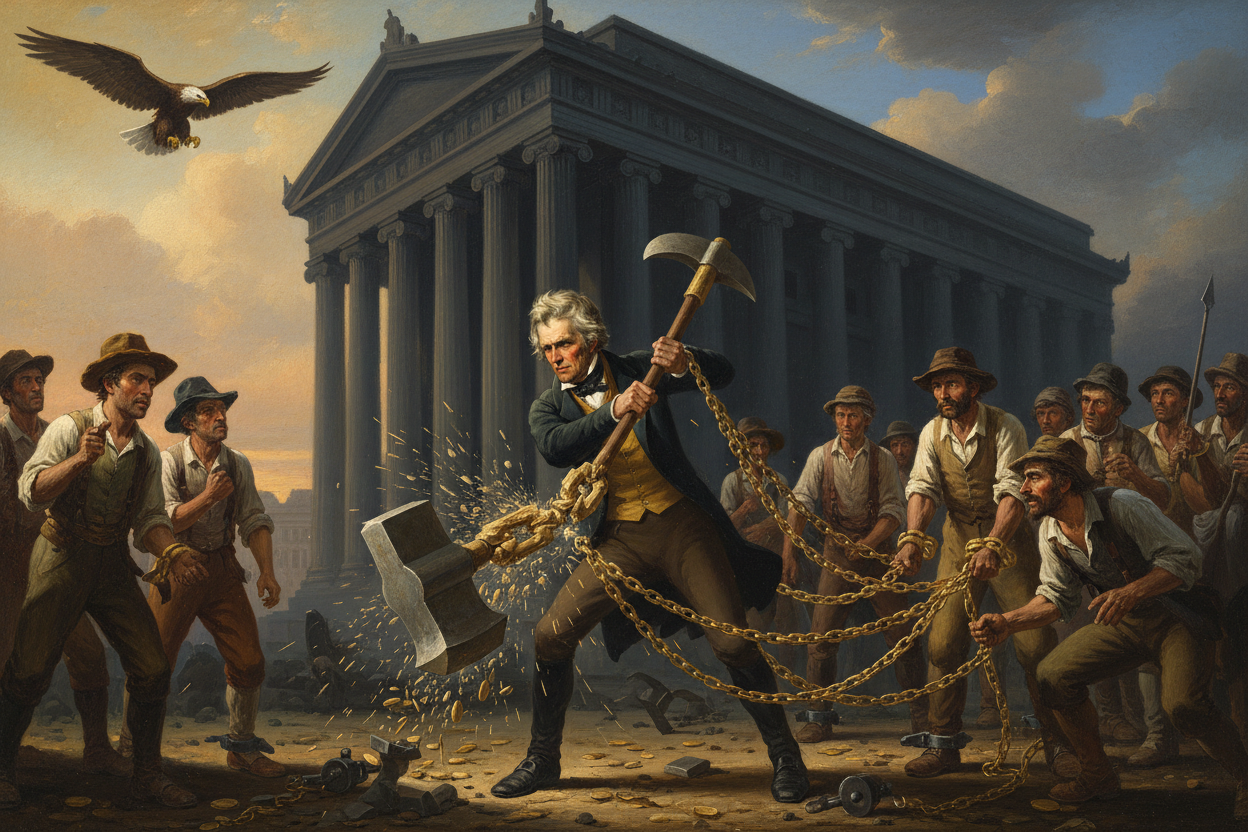
When Andrew Jackson declared war on the Second Bank of the United States in the 1830s, he wasn’t just fighting a financial institution—he was articulating a populist conservative vision that still resonates today. Jackson’s battle against what he saw as corrupt elites and their monopolistic practices gave birth to a strain of conservatism that champions the common man against establishment power.
Jackson’s approach combined conservative principles of limited government with populist appeals to ordinary Americans. His famous declaration that “the rich and powerful too often bend the acts of government to their selfish purposes” could easily be heard at a modern conservative rally. This moment showed how conservative ideology could adapt to include anti-establishment sentiment while maintaining core principles of constitutional government.
The Bank War also established the conservative tradition of skepticism toward financial elites and their influence over government policy—a theme that would resurface repeatedly in American political history.
The Civil War and Reconstruction: Redefining Federal Power
The Civil War created a profound tension within conservative thought that persists today. While the war preserved the Union and ended slavery—causes that many conservatives supported—it also dramatically expanded federal power in ways that made traditional conservatives uncomfortable.
The Reconstruction era forced conservatives to grapple with fundamental questions about the proper role of federal government. The Fourteenth and Fifteenth Amendments expanded federal authority to protect individual rights, creating what scholars call the “conservative dilemma”—how to support individual liberty while maintaining limited government.
This period also saw the emergence of what would later be called “constitutional conservatism”—the belief that even worthy goals must be pursued through proper constitutional means. The debates over Reconstruction amendments established precedents for how conservatives would approach civil rights issues for generations to come.
The Progressive Era: Conservative Response to Reform
The early 1900s brought a wave of progressive reforms that fundamentally challenged conservative assumptions about government’s role. From Theodore Roosevelt’s trust-busting to Woodrow Wilson’s expansion of federal agencies, the Progressive Era forced conservatives to articulate their opposition to big government in new ways.
This period crystallized conservative opposition to what they saw as social engineering and government overreach. The establishment of the Federal Reserve, the income tax, and direct election of senators all represented expansions of federal power that conservatives viewed with deep suspicion.
More importantly, the Progressive Era established the modern conservative critique of expert-driven government. When progressives argued that trained professionals should manage complex social and economic problems, conservatives countered with appeals to traditional wisdom, local knowledge, and constitutional limits on government power.
The New Deal: Defining Modern Conservative Opposition
Franklin Roosevelt’s New Deal didn’t just expand government—it redefined what Americans expected from their federal government. For conservatives, this represented an existential threat to constitutional government and individual liberty.
The conservative response to the New Deal established many themes that define modern conservatism: opposition to welfare dependency, concern about government debt, and warnings about the erosion of individual responsibility. When Roosevelt proposed packing the Supreme Court, conservatives rallied around constitutional principles and separation of powers.
This era also saw the intellectual foundations of modern conservatism take shape. Thinkers like Albert Jay Nock and Isabel Paterson began articulating a sophisticated critique of the welfare state that would influence conservative thought for decades. The New Deal taught conservatives that they needed not just political opposition but intellectual alternatives to progressive governance.
The Cold War: Anti-Communism and National Defense
The emergence of the Soviet Union as a global threat transformed American conservatism in fundamental ways. Anti-communism became not just a foreign policy position but a organizing principle that unified different strands of conservative thought.
The Cold War gave conservatives a clear enemy and a compelling narrative: the free world versus totalitarian communism. This struggle validated conservative arguments about the dangers of big government, centralized planning, and restrictions on individual liberty. When conservatives warned about the “road to serfdom,” they could point to actual examples behind the Iron Curtain.
The Cold War also established the conservative commitment to peace through strength—the belief that military preparedness prevents conflict rather than causing it. This principle would become central to conservative foreign policy thinking and remains influential in contemporary debates about defense spending and international engagement.
The Great Society: Welfare State Expansion
Lyndon Johnson’s Great Society programs represented the most ambitious expansion of federal social programs since the New Deal. For conservatives, this wasn’t just bad policy—it was a fundamental threat to American values of self-reliance and limited government.
The conservative critique of the Great Society focused on both practical and philosophical concerns. Programs like Aid to Families with Dependent Children, conservatives argued, created dependency rather than opportunity. The expansion of federal bureaucracy threatened local control and individual initiative.
This period also saw conservatives develop sophisticated arguments about the unintended consequences of well-intentioned government programs. The rise in crime, family breakdown, and urban decay during the 1960s and 1970s seemed to validate conservative warnings about the social costs of welfare state expansion.
The Reagan Revolution: Conservative Governance
Ronald Reagan’s presidency proved that conservative ideas weren’t just oppositional—they could govern effectively. The Reagan years demonstrated how conservative principles of limited government, free markets, and peace through strength could be translated into successful policy.
Reagan’s approach combined economic conservatism with social conservatism and strong national defense in ways that created a lasting coalition. His tax cuts and deregulation showed how conservative economics could generate prosperity. His military buildup helped end the Cold War peacefully.
Perhaps most importantly, Reagan showed how conservatives could communicate their ideas effectively to ordinary Americans. His optimistic vision of American exceptionalism and individual opportunity resonated far beyond traditional conservative constituencies, establishing a template for conservative political success.
September 11, 2001: Security and Liberty in Tension
The terrorist attacks of September 11, 2001, forced conservatives to grapple with fundamental questions about the balance between security and liberty. The creation of the Department of Homeland Security and passage of the Patriot Act represented exactly the kind of federal expansion that conservatives traditionally opposed—but in service of national security priorities they strongly supported.
This moment revealed tensions within conservative thought between different priorities: constitutional limits versus security needs, individual privacy versus collective safety. The debate over surveillance programs and enhanced interrogation techniques showed how external threats could complicate conservative principles.
September 11 also reinforced conservative arguments about American exceptionalism and the importance of strong national defense. The attacks validated conservative warnings about the dangers of the modern world and the need for American leadership in defending freedom globally.
Conclusion: The Continuing Evolution of Conservative Thought
These ten pivotal moments reveal how American conservative ideology has been shaped by historical circumstances while maintaining core commitments to constitutional government, individual liberty, and traditional values. From the founding debates over federalism to post-9/11 security challenges, conservatives have consistently adapted their arguments to new circumstances while defending enduring principles.
Understanding this historical development helps explain why modern conservatism takes the form it does—and why it continues to evolve. Each generation of conservatives has faced the challenge of applying timeless principles to contemporary problems, creating a rich intellectual tradition that draws from both philosophical foundations and practical experience.
As America faces new challenges in the 21st century, conservative ideology will undoubtedly continue evolving while remaining rooted in the lessons of these pivotal historical moments. The ongoing tension between change and continuity that has always characterized American conservatism ensures that this intellectual tradition will remain dynamic and relevant for future generations.