You got a raise this year. Congratulations.
But before you celebrate your raise, take a look at your bank account, your grocery receipt, and the total on the gas pump. Does it actually feel like you are getting ahead?
For millions of working Americans, the honest answer is no.
Your paycheck may be bigger than it was last year, but the cost of living has also increased. In some cases, everyday expenses are rising faster than wages. That means the number printed on your paycheck may have gone up while your actual purchasing power went down.
On paper, you earned more money. In real life, your money buys less.
The Truth About Your Raise
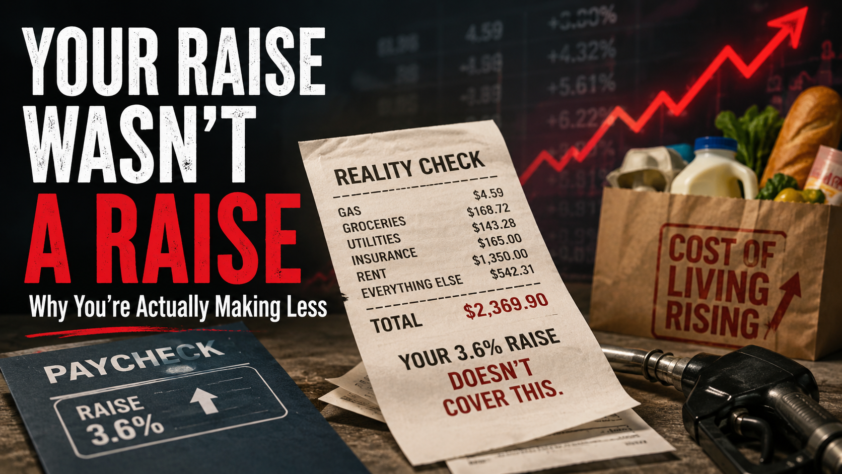
Imagine your employer gives you a 3.6% salary increase. At first, that sounds like progress. You might think you finally have a little more room in the budget. Maybe you can pay down some debt, build your savings, or stop worrying so much every time an unexpected bill arrives.
But then inflation rises by 3.8%.
The cost of groceries, fuel, utilities, insurance, rent, repairs, and other necessities increases faster than your income. Even though your raise added more dollars to your paycheck, those dollars lost some of their value.
You did not really move forward.
You lost ground.
Economists often describe this as a decline in “real wages.” Real wages measure what your income can actually purchase after inflation is considered. Most working people do not need an economics degree to understand the concept.
They experience it every week.
If your salary goes up but you can afford fewer groceries, less fuel, and fewer basic necessities, then your raise was not a true financial victory. It was simply a smaller pay cut disguised as an increase.
Visit the Consumer Price Index page
Your Paycheck Is Bigger, but Life Costs More
This is why so many Americans feel confused and frustrated.
They are being told that wages are increasing and that the economy is improving. Meanwhile, they are standing at the checkout counter wondering how a few bags of groceries became so expensive.
They are looking at their electric bills, car insurance premiums, rent payments, property taxes, and medical expenses and asking the same question:
Where did the extra money go?
The answer is that your raise may have been absorbed before it ever reached your pocket.
A few extra dollars per paycheck can disappear quickly when nearly every major household expense becomes more expensive. A higher salary means very little when the increased cost of food, transportation, housing, and insurance takes all of it—and then some.
The numbers may look better on a spreadsheet, but families do not live on spreadsheets.
They live in the real world.
Energy Prices Affect Almost Everything
One of the biggest drivers of higher household costs is energy.
When gas and diesel prices rise, the effects do not stop at the fuel pump. Nearly every product you purchase must be transported at some point. Trucks deliver groceries, clothing, electronics, building supplies, household goods, and countless other products to stores across the country.
When fuel becomes more expensive, trucking and shipping companies must pay more to operate. Those higher transportation costs are eventually passed down the supply chain.
Manufacturers charge more.
Distributors charge more.
Retailers charge more.
Finally, the customer pays more.
That means energy prices can reduce the value of your raise even when you do not personally drive very much. You still pay the higher transportation costs through increased prices on store shelves.
This is something blue-collar workers and truck drivers understand better than most. When the cost of moving products rises, the cost of those products usually rises too.
Nothing moves for free.
Working More but Affording Less
The most painful part of inflation is that people can work harder and still fall further behind.
You may be putting in overtime. You may have taken on additional responsibilities. You may have received a promotion or earned a salary increase after years of dependable work.
Yet somehow, you still feel financially stuck.
That does not necessarily mean you are irresponsible with money. It may mean the value of your income is being quietly reduced by rising prices.
This is why your raise should never be judged only by the percentage your employer gives you. You also have to compare it with changes in your actual cost of living.
How much more are you paying for groceries?
How much has your rent or mortgage increased?
What happened to your insurance premiums?
How much more are you spending on gas, electricity, water, repairs, and household supplies?
Those numbers tell you whether you truly received a raise.
The Number That Really Matters
The most important question is not whether you are making more money.
The real question is whether your money can do more.
Can you save more than last year?
Can you pay your bills with less stress?
Can you afford the same groceries without removing items from your cart?
Can you handle an emergency expense without using a credit card?
Can you provide your family with the same standard of living?
If the answer is no, then your raise may not have improved your financial situation at all.
A salary increase should increase your freedom, stability, and purchasing power. It should give you more options—not simply help you survive another round of rising prices.
Don’t Let the Bigger Number Fool You
Working Americans deserve to know the difference between earning more dollars and becoming financially stronger.
A larger paycheck can create the illusion of progress. But when inflation rises faster than income, that progress disappears. You may be earning more while becoming less capable of paying for the life you were already living.
That is not prosperity.
That is financial erosion.
So yes, be proud of your raise. You earned it. But do not let politicians, corporations, or economic reports convince you that a higher salary automatically means you are better off.
Look at what your money can actually buy.
Because at the end of the day, the value of your raise is not determined by the number on your paycheck.
It is determined by how much of your life that paycheck can still afford.
The question is whether your money is actually worth more.
For many families today, the answer is no.
Join Rock Nation – honest conversations and real connections