
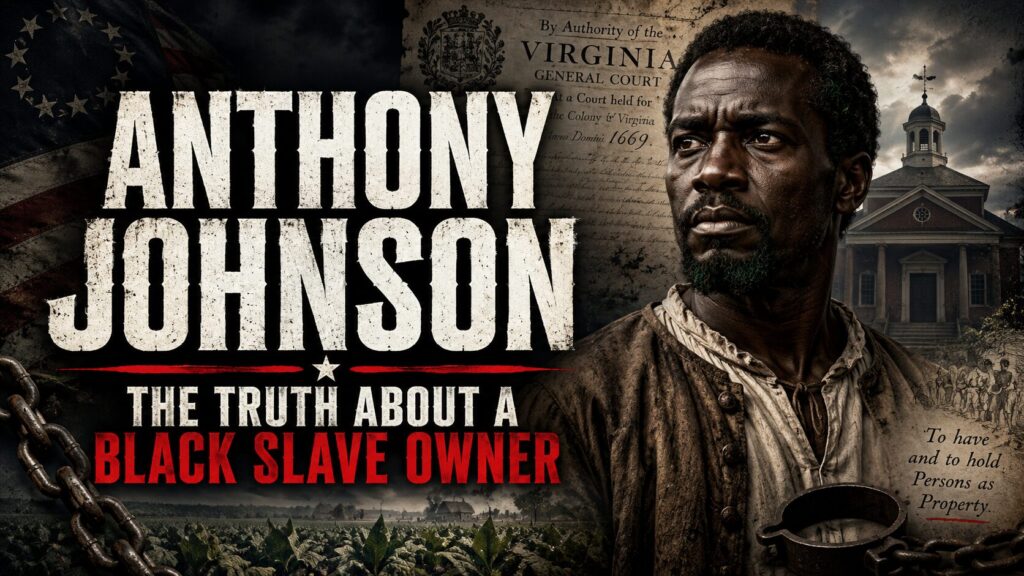
There are parts of American history we are encouraged to discuss constantly—and other parts we are expected to avoid because they make everyone uncomfortable.
The story of Anthony Johnson belongs in that second category.
You may have heard the popular claim that “the first slave owner in America was a Black man.” It is provocative, shocking and repeated all over social media.
It is also not completely accurate.
Anthony Johnson was not the first human being to own slaves on American soil. Enslavement existed in North America before his court case, and in 1640—15 years earlier—a Black man named John Punch had already been sentenced to serve a white planter for the remainder of his natural life. Historians therefore reject the claim that Johnson invented slavery or became America’s first slaveholder.
But correcting that exaggeration does not make the true story any less disturbing.
From Captivity to Landownership
Anthony Johnson arrived in Virginia in 1621 as an African captive known in colonial records as “Antonio.” Historians are not entirely certain whether his original legal status was slavery or some form of bound servitude. What we do know is that Johnson eventually gained his freedom, married a woman named Mary, acquired land and became a successful tobacco farmer. By the 1650s, the Johnson family controlled approximately 250 acres—an impressive achievement for any former servant in colonial Virginia.
Anthony Johnson’s life in colonial Virginia
This is where the story becomes complicated.
Johnson did not merely escape an oppressive labor system and build a better life. He eventually participated in that same system.
One of the people working for Johnson was a Black man named John Casor. Casor claimed that he had completed his original term of service—reportedly seven or eight years—and had then been forced to continue working for Johnson for roughly seven additional years. Casor eventually left Johnson and began working for a neighboring white planter named Robert Parker.
Johnson could have allowed Casor to leave.
He did not.
Instead, Johnson went to court and demanded that Casor be returned to him.
A Black Man Fighting to Own Another Black Man
On March 8, 1655, a Northampton County court ruled in Johnson’s favor. The court ordered that Casor be returned to Johnson and remain in his service for life. This was an important early civil ruling in which one individual successfully claimed another person as permanent property rather than as a temporary servant working under a limited contract.

That is the brutally honest part.
Anthony Johnson—a man who had personally experienced bondage—used the legal system to deny another Black man his freedom.
Why would he do that?
There is no surviving statement in which Johnson explains his personal motives, so anyone claiming to know exactly what was inside his head is guessing. But his actions tell us plenty.
Permanent labor was more profitable than temporary labor. An indentured servant eventually became free. A person enslaved for life did not. By demanding that Casor remain his property permanently, Johnson protected his workforce, his wealth and his position as a landowner.
In other words, he appears to have made the same decision powerful people have made throughout history: when forced to choose between another person’s freedom and his own economic interests, he chose his interests.
His skin color did not make that decision righteous.
His earlier suffering did not justify it.
And his personal success did not give him the moral right to own another human being.
Did Johnson Make Slavery Permanent?
This is another place where honesty matters.
Anthony Johnson did not single-handedly create American slavery. He did not write the later slave codes, invent racial hierarchy or personally establish the enormous system of hereditary chattel slavery that developed throughout the colonies.
Virginia’s 1662 hereditary slavery law
His 1655 victory was one decision within a larger transformation that was already taking place.
Fifteen years earlier, John Punch had been sentenced to lifetime servitude after running away, while the two white servants who escaped with him received only additional years on their contracts. That unequal punishment demonstrated that African laborers were already being treated differently under colonial law.
After Johnson’s lawsuit, Virginia’s government continued transforming slavery into a racial and hereditary institution. In 1662, colonial lawmakers declared that a child’s legal status would follow that of the mother, meaning children born to enslaved women would also be enslaved. In 1667, lawmakers declared that baptism would not free an enslaved person. Those laws—not one individual court case—helped build a permanent system that could reproduce itself from generation to generation.
Johnson’s case mattered because he actively participated in that developing system and successfully persuaded a court to enforce lifetime ownership in Casor’s case. But he should not be used as a convenient excuse to erase the governments, courts, merchants and plantation owners that later expanded racial slavery into one of the most brutal institutions in American history.
The truth does not require us to replace one dishonest narrative with another.
Slavery Was a Human Evil
Some people want to tell this story to mock Black Americans.
Others want to bury it because they believe acknowledging a Black slaveholder weakens the larger history of racial slavery.
Both sides are wrong.
Anthony Johnson’s story does not prove that racism was irrelevant to American slavery. The system that eventually developed was explicitly racial, hereditary and overwhelmingly controlled by white colonial governments and landowners. Johnson’s own family later experienced racial discrimination, and after his death a Virginia court declared that he was an alien because he was Black, allowing land connected to his estate to be seized.
But Johnson’s story does prove something else:
Human beings are capable of becoming the very thing they once hated.
A victim can become a victimizer.
A formerly oppressed person can gain power and then use it against someone else.
Greed, ambition and the hunger for control do not belong exclusively to one race.
That fact should not insult the Black community. It should remind every community that morality is determined by what a person does—not by that person’s race, political identity or historical category.
History Should Not Become a Permanent Excuse
This article is not meant to ridicule, insult or diminish the Black community. The suffering created by American slavery was real, massive and generational. Telling Johnson’s story does not erase those facts.
But acknowledging historical suffering should never require us to censor historical truth.
We should be able to admit that Black people were overwhelmingly victimized by American slavery while also admitting that some Black people participated in slave ownership. We should be able to condemn the system without pretending every historical figure fits neatly into the role modern politics assigned to them.
Most importantly, we must never allow legitimate historical grievances to become a permanent excuse for hopelessness, destructive behavior or a victim mentality that tells people they are powerless without government intervention.
There is a difference between recognizing that someone was harmed and teaching that person’s descendants they can never overcome that harm.
One produces understanding.
The other produces dependence.
And government benefits when Americans remain divided into permanent categories of oppressors and victims. As long as we are fighting over which race carries eternal guilt and which race possesses eternal innocence, we are not looking upward at the institutions that profit from our division.
The Truth Should Bring Us Together
Anthony Johnson’s story is not ammunition for a racial argument.
It is a warning about human nature, unchecked power and what people may become when money and status are placed above another person’s freedom.
We owe it to ourselves—and to the generations coming behind us—to know the entire truth. Not the sanitized version. Not the partisan version. Not the version designed to make one race feel permanently guilty or another race permanently helpless.
The truth should not be used to push Americans farther apart. It should help us put down the excuses, reject the victim mentality and recognize that ordinary people of every race have far more in common with one another than we do with the political institutions exploiting our pain.
Learn the history.
Tell it accurately.
Refuse to weaponize it against your neighbors.
Then use that truth to bring people closer together and start building real solutions for The People—not the government.
Because a united population that knows its history is difficult to manipulate.
And that may be exactly why we are rarely encouraged to learn the whole story.
Join Rock Nation – for real conversations like this one.