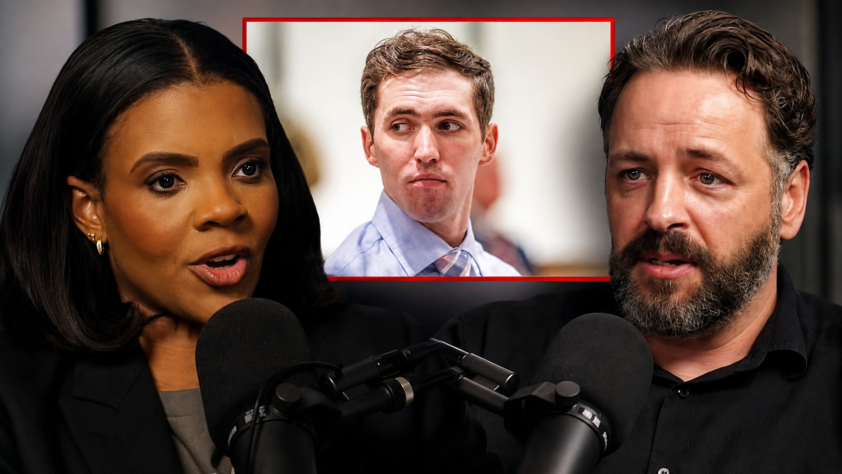
Candace Owens vs. Andrew Wilson: The Debate Over Tyler Robinson and the Charlie Kirk Case
The long-awaited debate between Candace Owens and Andrew Wilson became much more than a disagreement over one piece of evidence. It turned into a larger argument about what qualifies as evidence, when skepticism becomes speculation, and how much trust Americans should place in an official narrative before a criminal case has been fully tested at trial.
At the center of the debate was Tyler Robinson and the September 10, 2025 killing of Charlie Kirk.
Andrew Wilson entered the discussion arguing that the evidence against Robinson was, in his words, “overwhelming”—although he clarified that he meant he personally found the totality of the evidence highly convincing. Candace Owens, meanwhile, argued that the evidence presented so far does not convince her that Robinson was the shooter and that she believes there is evidence supporting the possibility that he was set up as a patsy.
Source: Watch the full Candace Owens vs. Andrew Wilson debate on the PBD Podcast
That disagreement created several hours of intense back-and-forth.
Andrew Wilson’s Case Against Tyler Robinson
For Andrew Wilson, the case shouldn’t be viewed by isolating individual pieces of evidence.
Wilson argued that the government’s case becomes convincing when the physical evidence, surveillance evidence, alleged confessions, witness testimony and text messages are considered together. During the debate, he described three broad pillars supporting his position: the testimony and messages, the physical evidence and the overall case presented by investigators.
One major point was the rifle authorities say belonged to Robinson and was recovered near the crime scene.
Wilson argued that finding Robinson’s rifle near the scene was significant evidence. The debate then moved into questions surrounding DNA, fingerprints, debris in the rifle barrel and whether those details strengthened or weakened the government’s theory.
Wilson’s larger argument remained consistent: a questionable detail does not automatically erase the rest of the evidence.
That became one of his biggest criticisms of Candace Owens. Wilson repeatedly challenged her to explain how unanswered questions could logically lead from “something doesn’t make sense” to the stronger conclusion that Robinson had actually been framed.
Source: Watch Candace Owens and Andrew Wilson debate the evidence against Tyler Robinson
Candace Owens Focuses on the Gaps
Candace Owens approached the case from almost the opposite direction.
Instead of asking whether prosecutors had enough evidence to make Robinson look guilty, Owens repeatedly asked whether the evidence actually proved what investigators appeared to be claiming.
One of the most heavily debated subjects involved DNA and fingerprints recovered from the rifle. Owens pointed to testimony regarding Robinson’s DNA contribution and other DNA associated with the weapon. She argued that the circumstances at least make it reasonable to investigate whether someone else could have handled or moved the rifle.
Wilson countered that this was a possibility—not proof that Robinson was framed.
That distinction became one of the central arguments of the entire debate.
Owens also attacked the quality of some surveillance evidence.
She questioned whether blurry images, clothing and footwear were enough to definitively identify Robinson. Wilson responded that individual images weren’t meant to stand alone; instead, they should be considered alongside messages, other surveillance footage and additional evidence.
This is really where the Candace Owens and Andrew Wilson disagreement became philosophical.
Wilson was evaluating the totality of the evidence.
Owens was examining each link in the chain and asking whether investigators had actually established it.
The Preliminary Hearing Became a Major Battleground
Another significant disagreement involved evidence presented during the preliminary proceedings.
Candace Owens repeatedly argued that much of what viewers heard during that stage involved hearsay permitted under Utah’s preliminary-hearing rules. Her point wasn’t necessarily that prosecutors were doing something improper. Instead, she argued that people shouldn’t treat everything introduced during a preliminary hearing as though it had already survived the evidentiary standards of a full trial.
Utah Rule of Evidence 1102 specifically states that reliable hearsay is admissible during criminal preliminary examinations and identifies several categories of evidence that may qualify. Rule 1101 also recognizes this preliminary-hearing exception.
Official sources: Utah Rule of Evidence 1102 — Reliable Hearsay in Criminal Preliminary Examinations | Utah Rule of Evidence 1101
Wilson pushed back on the way Owens characterized the hearing and argued that legitimate inferences can still be drawn from evidence even before a trial occurs.
That distinction matters.
A preliminary hearing is not the same thing as a conviction, and even Wilson acknowledged early in the debate that the state had not yet gone through the process of proving its case beyond a reasonable doubt at trial.
That may have been one of the most important points buried underneath all the arguing.
The Steakhouse Timeline Raises More Questions
The debate also addressed a claim in Owens’ timeline that Robinson visited a steakhouse.
Owens said she had spoken with the restaurant owner and believed there was enough supporting information to include the stop in her working timeline. She also said she would remove it if subsequent information disproved it.
Andrew Wilson pressed her on whether the payment had actually been independently confirmed as Robinson’s.
Owens acknowledged that further confirmation would strengthen the claim, while continuing to defend her decision to include the information as part of an ongoing investigation.
This exchange highlighted another fundamental disagreement between Candace Owens and Andrew Wilson.
Owens views her public timeline as something that can evolve as new evidence appears.
Wilson argued that including insufficiently verified information while simultaneously criticizing weaknesses in the prosecution’s evidence creates an inconsistent evidentiary standard.
That’s a legitimate question for viewers to consider.
Source: Full Candace Owens vs. Andrew Wilson debate and fact-check discussion
Israel, Turning Point USA and the Bigger Theories
The conversation eventually moved beyond Tyler Robinson.
Andrew Wilson challenged Owens over her previous statements and theories involving Israel, France, Turning Point USA and individuals connected with Charlie Kirk.
Owens argued that questions surrounding Israel developed partly because of disagreements Kirk had reportedly been having about the country’s relationship with conservative political figures and donors. She also argued that conflicting public accounts following Kirk’s death increased suspicion and deserved further examination.
Wilson’s response was simple: suspicion isn’t evidence.
Source: Watch Andrew Wilson challenge Candace Owens over her Israel theory
When the discussion turned specifically toward Turning Point USA and Erica Kirk, Owens said she had not accused them of murdering Charlie Kirk but maintained that she believes investigators should have asked more questions of people close to the situation.
Wilson argued that some of Owens’ previous public statements had gone considerably further than simply calling for additional investigation.
That became perhaps his strongest broader criticism of Owens: asking questions is legitimate, but making conclusions requires evidence.
Source: Watch Andrew Wilson question Candace Owens about Erica Kirk and Turning Point USA
Candace Owens and Andrew Wilson Both Claimed Victory
Neither side walked away convinced.
In his closing statement, Andrew Wilson argued that Owens had failed to produce solid evidence establishing that Robinson was a patsy. He conceded that viewers could disagree over how convincing the prosecution’s evidence was, but maintained that challenging the state’s case is fundamentally different from proving an alternative theory.
Candace Owens reached the opposite conclusion.
She argued that Wilson had failed to demonstrate that the case against Robinson was truly “overwhelming.” Owens maintained her belief that more people were involved and that Robinson had been set up, while emphasizing that she was willing to correct information when she believed she had gotten something wrong.
And that’s probably why the debate mattered.
It didn’t solve the Charlie Kirk case.
It exposed the enormous difference between evidence, inference, suspicion and proof.
The Bigger Lesson From Candace Owens vs. Andrew Wilson
You don’t have to believe everything Candace Owens says to believe investigators should face difficult questions.
You also don’t have to trust every government institution to recognize Andrew Wilson’s central argument: unanswered questions are not automatically evidence of a conspiracy.
Those two ideas can exist at the same time.
Skepticism is healthy.
Blind trust isn’t.
But neither is automatically replacing an official narrative with an alternative narrative before the evidence supports it.
The real test will come as additional evidence is examined, challenged and eventually subjected to the full legal process.
Until then, audiences should be careful about joining either team simply because they like Candace Owens or Andrew Wilson.
Look at the evidence.
Separate what is known from what is alleged.
And most importantly, keep asking questions—even when the answers don’t fit the side you started on.
Sources
Andrew Wilson Challenges Candace Owens’ Israel Theory
Candace Owens vs. Andrew Wilson: The Charlie Kirk Debate — PBD Podcast
Utah Rule of Evidence 1102 — Reliable Hearsay in Criminal Preliminary Examinations
Utah Rule of Evidence 1101 — Applicability of Rules
Andrew Wilson and Candace Owens Debate the Evidence
Join the Rock Nation community on Substack
Have questions about this post? Contact Us.