At some point, asking questions became more offensive than failing to answer them.
That is where we are with the investigation into Charlie Kirk’s death.
Independent voices like Candace Owens, Jimmy Dore and Baron Coleman have been mocked, discredited and treated like the problem—not necessarily because every question they have raised has been disproven, but because they refuse to stop looking.
You do not have to agree with every theory they discuss. I certainly do not accept every claim posted online as fact.
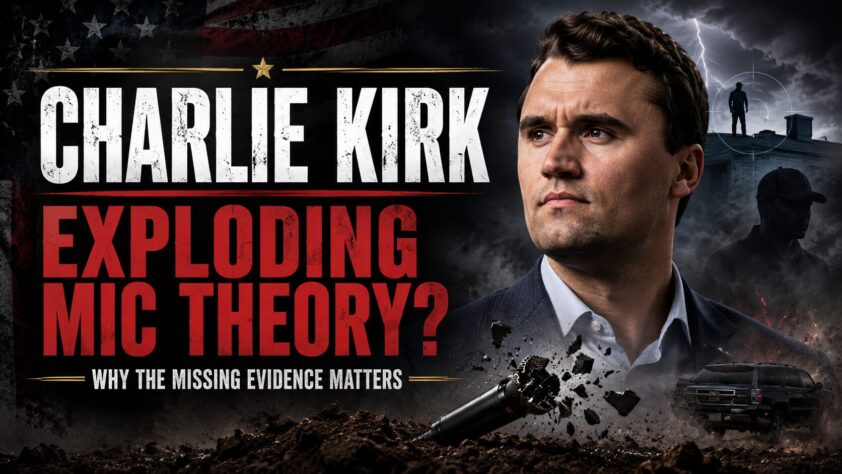
But questions about missing evidence, conflicting testimony, unexplained people at the crime scene and the Charlie Kirk exploding microphone theory do not disappear because an online influencer rolls his eyes and says, “Conspiracy theory.”
Official FBI updates on the Utah Valley shooting
If there is nothing to hide, answer the questions.
This Is Not About Declaring Tyler Robinson Innocent
Let me be clear from the beginning.
Tyler Robinson is accused of murdering Charlie Kirk. Prosecutors presented surveillance footage, DNA evidence, alleged confessions and testimony from Robinson’s former partner during the July 2026 preliminary hearing. The proceeding concluded without an immediate ruling, and final arguments are scheduled for September 1, after which the judge is expected to decide whether Robinson will stand trial.
That evidence cannot simply be ignored because people distrust the government.
But the unanswered questions cannot be ignored either.
This is not about choosing a team and defending it no matter what. This is about determining whether Robinson acted alone, whether another person participated or whether investigators became committed to one theory before fully examining the alternatives.
A strong case should survive serious questions.
The Rooftop Footage Does Not Answer Everything
Some online commentators claimed that they watched footage showing the rooftop suspect assemble the rifle, move into position and fire the fatal shot.
But the court record is more complicated than that dramatic description.
Video evidence reportedly tracks a person prosecutors identify as Robinson moving around campus, going onto the roof, crawling and fleeing afterward. However, the rooftop evidence described in court does not provide a clear facial identification or an unmistakable view of a person pulling a trigger.
One officer testified that he saw a person carrying a “long black object.” When directly asked whether he saw a gun, he did not positively identify the object as a firearm.
That does not mean the person was carrying a pool noodle.
It means investigators and commentators should accurately describe what the evidence proves—and what it does not.
The same officer was accompanied onto the roof by a civilian-dressed man who appeared to be armed. The officer could not immediately identify who that man was in the testimony highlighted by the defense.
Maybe that person was a legitimate federal or local officer.
Fine. Identify him.
In one of the most important crime scenes in the country, every armed person entering that rooftop should have a name, an agency, a reason for being there and a documented record of what he touched.
That is not paranoia.
That is basic accountability.
What Is the Charlie Kirk Exploding Microphone Theory?
The Charlie Kirk exploding microphone theory suggests that the small wireless microphone positioned against or beneath Kirk’s shirt may have been replaced, modified or used to conceal a focused explosive device.
This has not been proven in court.
There is currently no publicly verified forensic finding establishing that Kirk’s microphone contained explosives or that explosive residue was recovered from his body.
But independent researchers point to photographs reportedly taken inside the SUV used to transport Kirk. Those images appear to show shattered black fragments with white markings. Some researchers believe the fragments resemble pieces of the wireless microphone Kirk was wearing.
They may be right.
They may be completely wrong.
That is why evidence is supposed to be preserved and tested.
Instead of declaring through screenshots that the fragments definitely came from the microphone, investigators should have collected them, photographed them, chemically analyzed them and compared them with the exact microphone model.
But according to the source material, the SUV was cleaned, released and later sold.
If that is accurate, how do you properly examine it now?
How do you test the seats, carpet and interior surfaces for explosive residue?
How do you determine where the fragments originated?
How do you prove the microphone theory wrong when the vehicle allegedly containing the evidence no longer exists in its original condition?
Ten Inches of Soil Reportedly Removed
One of the most troubling claims involves the physical area where Kirk was struck.
A contractor’s account discussed in the uploaded material alleges that approximately ten inches of soil were removed from the location shortly after the killing and that the area was paved.
Maybe investigators thoroughly processed the location before the work began.
If so, release the documentation.
Show what soil samples were collected, who authorized their collection, where they were tested and whether investigators searched for explosive compounds, microscopic plastic, metal fragments or other residue.
Because if a device exploded near Kirk’s body, the surrounding ground might have contained evidence capable of proving or disproving that theory.
You cannot remove the soil and then act offended when people ask what might have been inside it.
Where Were the Bomb-Detection Dogs?
The uploaded accounts also claim that bomb-detection dogs were present or available but were not brought to the immediate location where Kirk was struck. They were reportedly used in other areas connected to the search.
There may be a reasonable explanation.
Perhaps handlers were assigned to search for the rifle or suspect. Perhaps investigators already believed they were dealing exclusively with a firearm. Perhaps other safety concerns determined where the dogs were deployed.
Then explain it.
If an explosive device was even remotely possible, bringing trained dogs to the immediate area would appear to be an obvious precaution.
When you combine the alleged absence of bomb dogs with the removal of the soil, suspicions are predictable.
That does not prove officials intentionally avoided finding explosive residue.
But it does create a valid question:
Why was the scene apparently handled in a way that could make testing the theory nearly impossible?
The Missing Shirt and Returned Necklace
Charlie Kirk’s shirt may have been one of the most important pieces of physical evidence.
If a device detonated near his chest or neck, the shirt might have contained residue, heat damage, tearing, embedded fragments or directional patterns.
According to accounts provided in the source material, Brian Harpole claimed he cut the shirt off inside the emergency room. Medical professionals responding to that story have questioned whether an unauthorized security person would have been permitted to take control of a trauma room and remove the clothing while hospital employees stood aside.
Regardless of where it was removed, the critical question remains:
Where is the shirt?
It has not been publicly identified as preserved evidence in the material reviewed for this article.
Then there is Kirk’s necklace.
The uploaded accounts claim investigators searched for it, but it was eventually returned to Erika Kirk rather than remaining secured for forensic examination.
I understand the emotional desire to return a husband’s personal belongings to his widow.
But emotional significance does not erase forensic significance.
A necklace positioned close to the fatal wound might contain microscopic evidence. It should have been completely documented and tested before being released.
The same goes for the shirt, microphone, jacket and vehicle.
What About a Second Shooter or Second Actor?
The phrase “second shooter” does not necessarily mean another person firing from a different rooftop.
A second actor could be someone who handled the microphone, exchanged equipment, activated a device, helped create a diversion, planted evidence or assisted the person seen fleeing.
The ballistics examination also failed to conclusively connect the major bullet-jacket fragment recovered during the autopsy to the rifle associated with Robinson. The examiner testified that the fragment could neither be identified nor excluded as having been fired from that rifle. The comparison was inconclusive.
That does not clear Robinson.
“Inconclusive” does not mean “innocent.”
But it also does not mean the rifle was scientifically proven to have fired the fatal projectile.
That distinction matters when the government is seeking the death penalty.
Stop Attacking the Questions and Start Answering Them
The FBI, local government and online defenders of the official narrative should not be working harder to attack independent researchers than to answer the questions they are raising.
Why was the soil removed?
What testing was performed first?
Why were bomb-detection dogs reportedly not taken to the immediate location?
Where is Kirk’s shirt?
Was the necklace forensically tested before being returned?
Where is the microphone?
Who authorized the SUV to be cleaned and sold?
What were the fragments inside it?
Who was the unidentified armed man on the roof?
Why is the ballistics result inconclusive?
Maybe every question has an innocent answer.
Then provide the answers.
A legitimate investigation should welcome credible outside information—even when it comes from people the government does not like.
Because when evidence disappears and the loudest response is to attack those who noticed, public suspicion is not irrational.
It is inevitable.
The Charlie Kirk exploding microphone theory may ultimately be disproven.
But here is the uncomfortable truth:
When the shirt is missing, the necklace has been returned, the SUV has reportedly been cleaned and sold, the soil has allegedly been excavated and the bomb dogs were reportedly kept away from the immediate area, properly disproving the theory becomes much more difficult.
And that leaves us with one final question:
When officials and their online defenders spend more energy attacking the people searching for evidence than explaining why the evidence was not preserved, maybe the questions are not what they fear.
Maybe they are afraid of where the answers could lead.
Join Rock Nation – for real conversations and connections